
Richard Florczak now Podcasts from Murrells Inlet
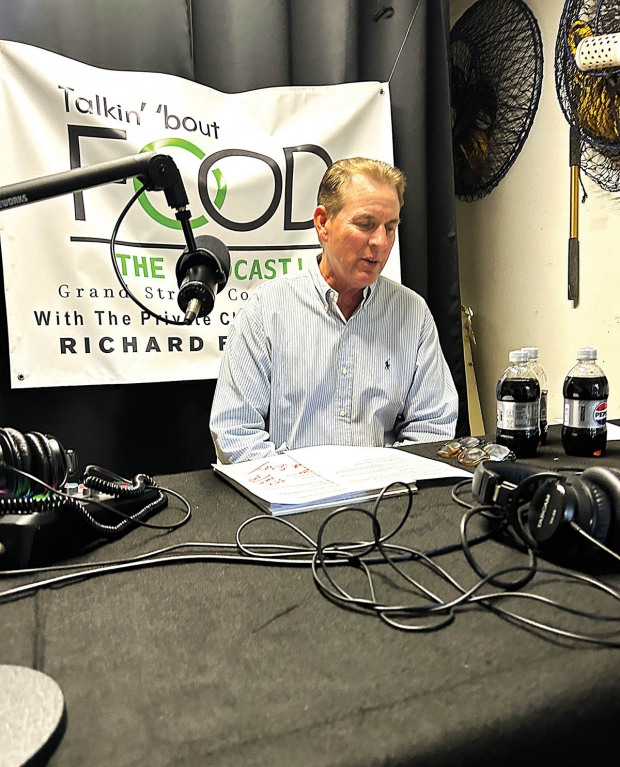

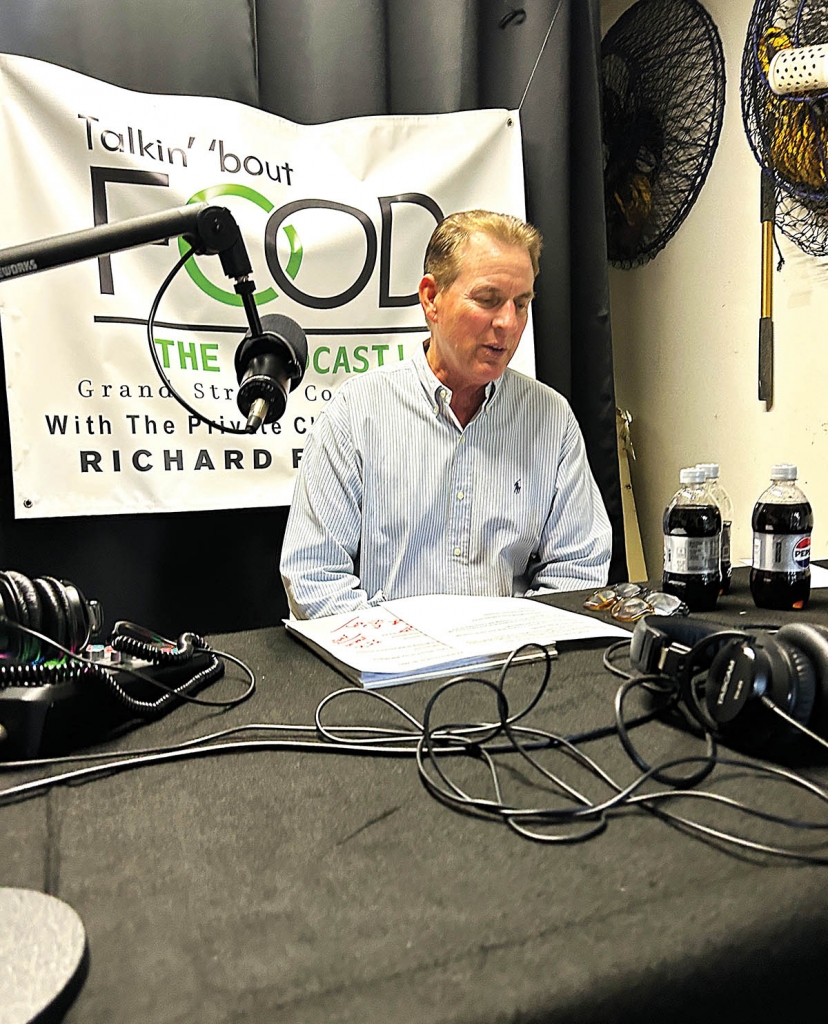


As the “private chef to the stars,” Richard Florczak shares stories, interviews of local and regional foodies, along with the occasional celebrity. He educates and entertains his listeners with his podcast Talkin’ 'bout Food, now in its second year.
The widely available podcast has originated weekly (more or less) from his garage-turned-studio in Murrells Inlet since September 2024. His focus is on the people, food and restaurants of the Grand Strand, and less about the stars with whom he worked and traveled: Tom Cruise, Mel Gibson, Kenny Wayne Sheppard, Christina Aguilera, Kevin Nealon, and others.
Retired from his work with the stars and retired from an upscale pizzeria he owned and operated in L.A., Florczak and his wife, Heidi, followed through on their plan to escape the overcrowded and expensive lifestyle of Los Angeles, and what he describes as the sometimes-difficult business environment of Los Angeles County, California. They found their home in Murrells Inlet in 2021.
“I’m not really retired,” says Florczak, 67, “and I don’t think I’ll ever be. But we’re not under immense pressure to work full-time. Heidi continues to work remotely for the Federal Aviation Association, and I create the podcasts and work as a private chef for a local couple twice per week.”
In their idyllic Murrells Inlet neighborhood, just feet from the creeks and marshes beloved by residents and visitors, Florczak, originally from New Jersey, is finding his way as a Southerner, a podcaster and private chef. He’s also learning about the immense culinary world of the South in general and of the Grand Strand in particular. We wondered what a typical day might look like for the chef/podcaster and caught him on a day in which he did both—recording a podcast, his 45th, and creating an exquisite evening meal for his clients.
Back from a shopping trip, Florczak stores groceries and moves to the studio. There he sits at his desk, adjusts microphones, sets audio levels and seems relaxed behind the considerable tech that is required of a podcaster. For the uninitiated, a “podcast” is like a radio show, with a host, guests, sometimes with commercials, and bumper music for intros and outros. Unlike radio, most podcasts are pre-recorded and archived so the listener can tune in when it’s convenient, or if they want to re-listen to a particular show.
Today, Florczak is expecting Joseph Bonaparte, Executive Director of the Horry-Georgetown Technical College’s International Culinary Institute of Myrtle Beach.
“Joe’s great and he’s been my guest before,” says Florczak, who will repeat guest visits on occasion, especially high-profile guests who have years of knowledge and experience, and who always have more to talk about. Bonaparte’s international experience, solid resume, and long list of credentials and awards make him a good fit. While waiting for Bonaparte, and yes, Joe believes he’s distantly related to the slightly more famous General Napoleon Bonaparte, I ask Florczak if he ever interviews his old celebrity buddies or tells tales out of school. He smiles.
“If you saw the pages and pages of legal documents I’ve signed swearing secrecy you’d be floored,” he says. “I respect their privacy and understand how being in the public eye is immensely stressful. So no, no stories. Saying that, I did interview Kenny Wayne Sheppard and Mel Gibson when I first got the podcast rolling.”
But no headline-grabbing gossip?
“Not ever. Generally, I’m comfortable sharing details of my life and job when I was working for them, but I have to be very careful. Paparazzi [among other things] want to know what the stars are eating. They’re relentless. When I was in London and Tom [Cruise] was doing Mission Impossible, paparazzi would wait for me to return to the hotel from the grocery store. They’d scream up to the taxi on motorcycles to try to shoot pictures of the groceries in my bag.”
Still, off the record, and off the air, Florczak will reminisce about a time he seems to cherish and about the jobs and people he really liked, both celebrity and civilian.
“For the first three decades I was there I loved it,” he says. “It was mine. L.A. was my city.”
But it came with a dark side not uncommon in the hospitality industry. While in California he first faced his own personal demon of alcohol abuse, which he comes to terms with daily after 30 years of sobriety. Florczak credits Alcoholics Anonymous and his brother, along with friend, composer/performer Paul Williams, for getting him straightened out. The Grammy-winning Williams has previously been a guest on Florczak’s podcast.
With a knock on the door Bonaparte arrives and finds his place at the studio desk. I’ve been invited to join in on the conversation. After a few minutes of re-introductions and chit-chat, he asks us to don our headphones and do a microphone check. All is well and Florczak, who’s become old hat at this, gets the show started with a push of a button, a swell of upbeat rock ‘n’ roll and a standard introduction of the podcast and his guests. The three of us settle in for a fun and lively 25-minute discussion of all things food and how it relates to the Grand Strand.
Bonaparte shares a few stories, talks about the new programs at the school, the school’s bistro and dining room, which is open to the public, and the passion most of his students have for creating and learning. He shares a few of the challenges all schools are facing, and of his aspirations for things to come.
Florczak is at ease behind the mic, asking relevant questions and interjecting a bit of commentary where appropriate. He has a rich voice, a radio voice, along with a slight but recognizable Jersey accent, and I tease him about it.
“Forty years in California and I didn’t lose it,” he says.
Florczak credits friend and local radio personality Liz Calloway for taking him under her wing and helping him think through how to make the podcast in its earliest days.
“I couldn’t have done it without her,” he says. “Plus, I’m a podcast junkie. I listen all the time. I listen to podcasts on how to make podcasts.”
By his own admission, Florczak has not yet marketed Talkin’ 'bout Food to its full potential.
“Weekly listenership fluctuates and has plenty of room for growth,” he laughs.
With the podcast recording complete—he’ll edit its content later—we move to his kitchen, and while preparing a long-simmering marinara sauce, he tells me more of his story.
“I followed my brother from New Jersey to L.A. and thought I wanted to be a screenwriter, having never written a word, and within six months realized I wanted nothing to do with the movie or television industry,” he says. “I was young, late 20s, and a buddy of mine found a job as a dishwasher at a hospital and told me the money was good and that I should work there, but I did not want to wash pots. Then he said, ‘Rich, there are tons of chicks working here,’ and I said, “’Sign me up.’”
“After six months of washing pots, I couldn’t stand it anymore and was ready to quit, and the chef called me over and said, ‘I notice you’re always watching what we’re doing. You want to come and work with us?’”
Florczak jumped at the chance.
Bad hospital food is an “old cliché,” says Florczak, but at this particular hospital they had hired older, talented, but retired restaurant chefs who didn’t like the pace of the restaurant work any longer and had come on board at the hospital.
“My training to eventually be a private chef came from that place,” recalls Florczak. “All the dietary restrictions—low fat, low sugar, low sodium, etc.—from people in a hospital, and the ability to make the food taste good, is something that transferred over.”
“I realized then that I loved cooking, so I went to the UCLA chef’s program on the weekends and started working for caterers. I also scored a job at the world-famous Hotel Bel Air in L.A. as a room service waiter. This was, and still is, considered one of the finest hotels in the world. About three weeks in, I delivered food to George Harrision, one of many very high-profile names that stayed there regularly. George would go on to stay for several weeks, and I probably waited on him 25 times. My last time serving his food he opened the door and said, “Hello Richard,” and it made my day that a Beatle would know my name. I’ll never forget it.”
The experience at the hotel taught Florczak other valuable career lessons.
“I not only learned about fine food, I learned about great service, the guarded privacy of celebrity guests, and I got over being star-struck. I learned how to conduct myself in the presence of people, anyone, in the public eye.”
All of his early experiences became key ingredients, pardon the pun, for his life as a private chef to the stars.
“I’d worked for restaurants with the pots and pans flying and all the screaming and knew I didn’t want that. I also worked for a caterer regularly. I overheard one of the chefs talking about working full time for [actor] Amy Irving. He told me he worked five days a week as her private chef. He told me about the agencies around town that handled this kind of work and gave me permission to use him as a reference.”
“The first Job was an interview to work for Sylvester Stallone, which I didn’t get, and was very depressed about, but the next day they set me up to interview with an elderly couple in their 80s. They had a fulltime secretary, live-in housekeeper, a fulltime driver who drove them around in their Rolls Royce, a British butler, James, who had trained at Buckingham Palace. They needed a private chef and I was hired.”
Florczak and James became friends and he lasted four years in the position. When deciding it was time to move on, he got a tip from one of the housekeepers that her agency was helping Tom Cruise look for a private chef.
“I showed up at the agency knowing that I was not supposed to know it was Tom Cruise I was interviewing for, and the manager looked at me and my resume and kind of chuckled. I was given the ‘you need more experience,’ line and I said, ‘Get me the interview and I guarantee you I will get the job.’”
His moxie paid off and after a few rounds of cooking at the Cruise home, got the job. Not surprisingly, Florczak told me the “Cruises” [Tom Cruise and then wife Nicole Kidman] were “healthy eaters.”
“I liked to make fresh handmade pastas for them, grilled fish, and served lots of vegetables. Tom was very health conscious. He worked out like he was constantly in training for the Olympics,” Florczak recalls.
“By the way, most celebrities don’t eat five-star stuff, or art on a plate every night,” he says. “They like a burger, a steak, a pasta dish.”
While looking over the evening’s menu and making mental calculations about timing, we continue our discussion. I asked Florczak how far back his love of food might really go.
“My mother was a fantastic cook,” he notes, “but I didn’t realize it until I went to culinary school. She was a people pleaser. She would make two entrees for my dad each night in case he didn’t like one. As a kid I thought that was the way everyone did it.”
In L.A., after two busy years, Florczak would part ways with Tom Cruise in a friendly split.
“I burned out and was treating the stress with booze,” he states. “Even before I started I knew it was going to be tough work with Tom. Lunch and dinner six days a week and a lot of travel. I burned out.”
Unfulfilled and underemployed (though a chef can always find something to do), Florczak ran into an old friend and neighbor from New Jersey. They had lunch and he told her he had parted amicably with Cruise.
“It turned out she worked for Mel Gibson,” recalls Florczak, as if he still can’t believe the ways in which the universe aligns itself. “She told me he was looking for a private chef. At first, I told her I was kind of over the celebrity work thing, but she encouraged me to interview anyway because she really liked them and thought I would, too. I was interviewed by Mel’s wife [Robyn Gibson] and she offered me the job. There’s an unwritten rule in the private chef world. You’ll last two years because either they will get tired of you or you’ll get tired of them. I stayed with the Gibsons for 13 years. Really great people.”
Florczak also worked for Leonardo DiCaprio, Jennifer Garner, and Christina Aguilera during that period on an occasional but recurring basis. For four summers in the NBA’s off-season Florczak prepared breakfast, lunch and dinner for Tyson Chandler, NBA champion and U.S. Olympian.
“Another truism in the private chef world is that at least fifty percent of getting hired by a celebrity is trust. They must trust you with the details of their personal lives. You see them at their best and their worst. They’re just like every other human being on the planet. The other fifty percent is the food.” With good references from past jobs and their associated celebrities, Florczak had been able to parlay one job into the next, but it was time for a change. After 13 years with the Gibson household, in 2013 Florczak opened the upscale Flame Pizzeria.
“We served traditional Neapolitan pizza,” he says. “My flour came from Naples [Italy], and my sourdough starter came from that region. You have to understand starters. The age of a starter is irrelevant; it’s where it came from. The natural yeast blowing in the wind of a particular region around the world is why you get great sourdough in San Francisco, great pastries in France, and great pizza in Italy. My yeast was from as close to Naples as I could get. My pizza oven was all wood-fired, no gas lines hiding in there, and was in the center of the dining room. The frustrating thing about it was that we were busy but not really making any money. California—Los Angeles County in particular, is a tough place to do business.”
Florczak owned and operated the popular and highly rated restaurant for nine years before selling and moving to Murrells Inlet.
“One day I was sitting by myself in the restaurant, and I thought ‘what could make me leave this place I love?’ And the answer was somewhere warm, with friendly people, and the fishing was great. I went to my computer and Googled that very thing—warm, friendly people and great fishing—and this place I’d never heard of kept popping up. Murrells Inlet. We visited. I was here for five minutes and knew it was right.”
The aroma of rich, red marinara with a subtle crab essence filled the kitchen as I asked how this new private chef opportunity came about.
A mutual friend had mentioned Florczak to a couple he knew and vice versa. Both parties wanted to meet. After interviewing for the job, Florczak accepted an offer to cook twice per week for the couple with a few caveats.
“The interview goes both ways,” says Florczak, “everyone needs to be on the same page. It took me a little time to zero in on what they liked and wanted, but we got there. It’s tricky. People like ‘home cooking.’ But home cooking is different in every home. I’ve asked five locals how they make their red rice and I’ve gotten five different answers.”
In an interview, Florczak will ask prospective clients about red meat, chicken or fish, ethnic food, vegetarian, etc.
“Their answers almost form an algorithm that will punch out a ticket and tell me what to make for them. One of my favorite questions is ‘do you require organic?’ I would prefer the answer to be ‘no,’ because it tells me a lot about them, that they’re not fussy or terribly demanding.”
Florczak also must mesh with his client’s personalities. Of his new clients in Murrells Inlet, Florczak says “they’re angelic, wonderful people.” They asked for traditional southern cooking, which had not been in his wheelhouse to any great degree, and it gave him something new to learn.
“I already knew the basics but am learning the popular southern dishes and it’s been very rewarding, fun.”
Florczak explains that a certain percentage of clients prefer not to micro-manage their own menus and consider it a luxury to have a private chef make those food decisions for them.
“They’ve hired someone and talked about their likes and dislikes, and they don’t want to worry about it anymore,” he explains.
Tonight, the first course will be angel-hair pasta with local blue crab marinara sauce. His secret is making a pot of simmering marinara and throwing in a half-dozen blue crabs, shell and all. They will simmer in the sauce most of the day. This is the only part of the meal Florczak will prepare in his own kitchen.
At the Murrells Inlet home of his clients, Florczak arrives with a pot of marinara that’s been simmering all day. He makes himself at home in their kitchen, keeping the all-day marinara warm while preparing the second course: local Mahi Mahi Three Ways—three whitefish Mahi filets with three different sauces. Each filet is prepared differently—grilled with Beurre Blanc, sauteed with cilantro-pesto, and Panko fried with an Asian black bean sauce.
While juggling all these elements, he serves the first course and has the fish, which takes only a few minutes to cook, on the ready. He won’t rush the meal or his service.
The first two courses are served and completed. For dessert, a Southern Chocolate Pie will finish the meal. With all the courses served family style, the first course pasta dish, the Mahi entrée and dessert, Florczak completed the hardest part of the task. Then he cleans the dishes and any kitchen messes, packs up what is his and heads home.
Back at home to have his own family dinner with Heidi, Florczak is already thinking about the next meal for his clients and the next podcast. Such is the day for a personal chef, podcaster, friend of Hollywood’s A-listers, and friend to the foodies of the Grand Strand.
“At this point in my life, as much as I love cooking, I love talking about it even more.”
Listen to Richard Florczak and Talkin’ ‘bout Food by visiting www.iHeartRadio.com and clicking the link to ‘Podcasts.’