
Out of the Ark delivers Animal Rehabilitation and Edu-tainment

Why are we all so fascinated by animals? Is it because human and animal interaction dates back nearly as far as the fossil record will let us see? Or that we’re together in every ancient manuscript? Is it because we see ourselves in their curious faces? Their mischievous eyes? Or is it because many animals are simply cute and cuddly?
Both the questions and the answers are deeply and mysteriously complex.
Ryan LaPierre, 33, of Myrtle Beach, opened Out of the Ark in 2023, in part, to help ease our curiosity, something he says is “universal to young and old.” The small company’s slogan sums up its business model quite well: “We Bring the Zoo To You.”
LaPierre let us accompany him on just a few of his rounds along the Grand Strand to see what operating as a mobile wildlife conservationist, animal caretaker, rehabilitator, entertainer, and educator might look like.
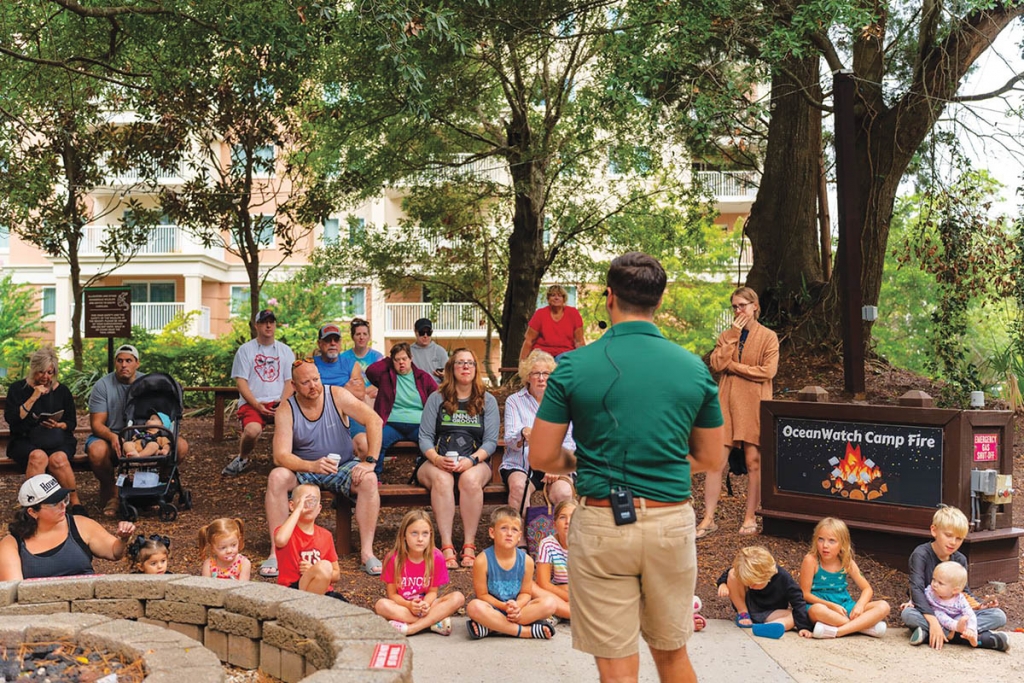
We meet in the quiet, forested garden of the Ocean Watch Resort, situated along the north end of Myrtle Beach. LaPierre is a regular here with weekly visits (sometimes more) and is now entering his second year. These visits are only open to guests of the resort, but he takes his menagerie of mammals, reptiles, amphibians, and birds to plenty of spots open to the public as well.
He’s been at work since 6:30 a.m., waking up the animals, feeding them, doing daily welfare checks and determining who will go into public on any particular day. Each animal has its own unique personality and moods, and as is true for the rest of us, has good days and bad. No one is forced to work if they’re not feeling up to it.
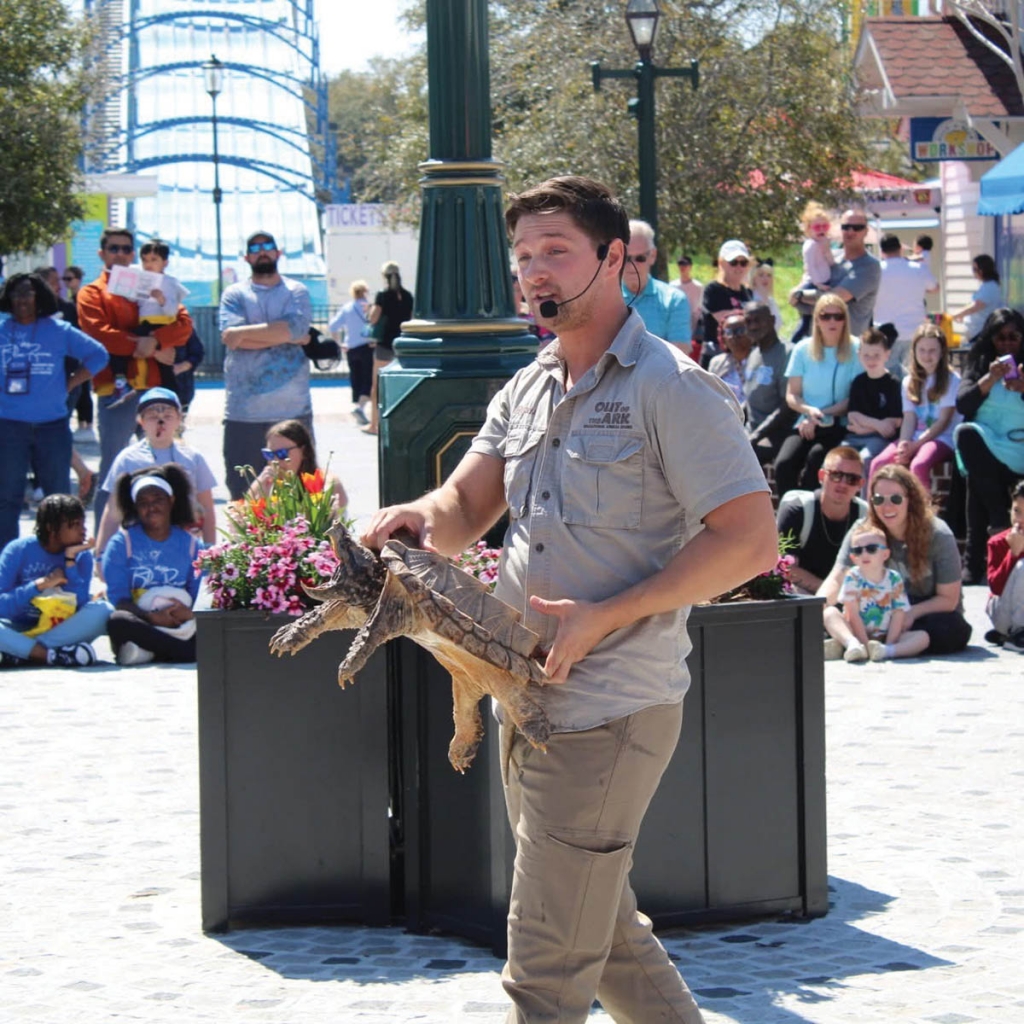
Wearing proper safari gear, LaPierre is set up with a headset mic, a small p.a. and a broad, friendly smile, an absolute requirement of the job. This former U.S. Army infantryman (10th Mountain Div.) had put himself through college after serving and achieved a B.S. in Wildlife Biology from Husson University and later a Master Herpetologist certificate from the Amphibian Foundation.
“My education was important, but college didn’t teach me most of what I know,” LaPierre says. “It was a hands-on experience. Even as a kid I spent a lot of time with my nose buried in a reference book studying pretty much any animal I could find. I got a lot of that from my dad, who encouraged my interests.”
Why Myrtle Beach?
“In the Army I was stationed at Fort Drum, N.Y. (near the Canadian border) and I spent a couple of winters there. Don’t want to do that again,” he laughs. “I joined the Army two weeks out of high school and stayed in just under three years.”
LaPierre was born in Massachusetts, moved to Florida and throughout the Carolinas before joining the military.
“I had exotic pets when I was younger and enjoyed learning about them and sharing with other people. Around 2022 I got more serious about it, and started in Massachusetts, but wanted a spot that was busier and maybe more touristy. We had vacationed here in Myrtle Beach many times, and it seemed like a great spot, so my husband Alex and I moved to Myrtle Beach and opened Out of the Ark.”
A small crowd, mostly kids and their handlers, have arrived and they sit in a semi-circle awaiting LaPierre’s greetings.
“Good morning everyone!” he says with genuine enthusiasm. He goes on to introduce himself, Out of The Ark, and then offers a few pro-tips on animal etiquette and what to expect.
“We are going to show you some wonderful animals, teach you a couple of cool things, and hopefully make you want to protect them. Whether you’re five or ninety-five, we want you to leave here with a new and healthier respect for our wildlife and the places they come from.”
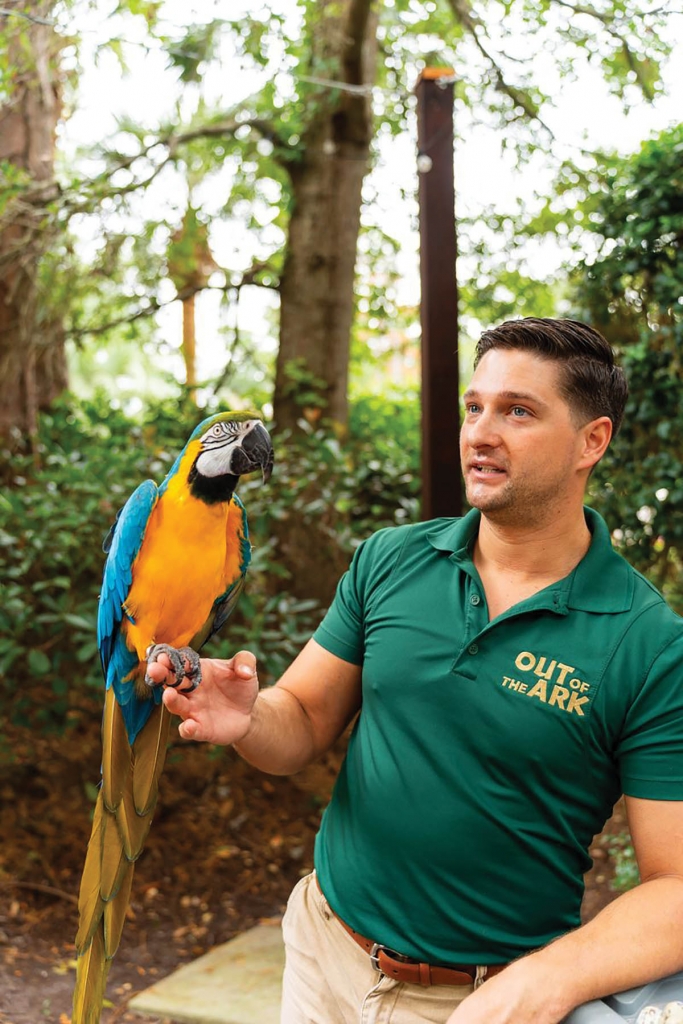
First up is Max, a four-year-old macaw. She’s a “shy talker,” says LaPierre, but when the mood strikes, watch out.
“Max is one of our many rescue parrots,” he says. “We get calls from along the whole eastern seaboard to take in birds and assist with law enforcement in seizures. She came from Rochester, NY, where she was surrendered. Most of the animals are seized in animal cruelty investigations.”
Later LaPierre privately tells me some of the details that are maybe not so appropriate for younger ears.
“We see a lot of macaws in drug houses,” he says. “Drug dealers seem to like to keep them as a status symbol. Even well-meaning people get these birds as pets and haven’t done their research and then realize they can’t keep them.”
Just how smart are these birds?
“She can solve puzzles, express emotion, and possesses the brain power of a five-year-old.”
Like any intelligent being, these animals can and sometimes have behavioral issues.
“All of our parrots swear,” continues LaPierre, privately. “They were all rescues and apparently heard a lot of arguments and name calling in their former homes. Max came from a home that was divorcing, and she will replay parts of the arguments between the husband and the wife. Lots of f-bombs, grumbling under their breath. It gets wild. She gets in these moods where I guess she’s thinking about the yelling, recreating it, yelling back and forth to herself. We have another very vocal parrot who also swears and they sometimes cuss at each other until I finally have to yell “Stop!” Max can cry like a baby, mimic a perfect human laugh, but she also says “I love you,” and “good morning,” and is generally a sweet girl.”
So Max is a girl?
“We named her Maxwell when she first came to us, but later found out she was a Maxine, but we were settled on Max. There’s no way to sex a macaw besides a DNA test or surgery. There is no obvious external sexual dimorphism between the male and female. Unlike other bird species, both male and female are decked out in full color.”
“Max will hopefully live her full life, 75-80 years, which means she will likely outlive all of the adults standing here,” he says to the crowd.
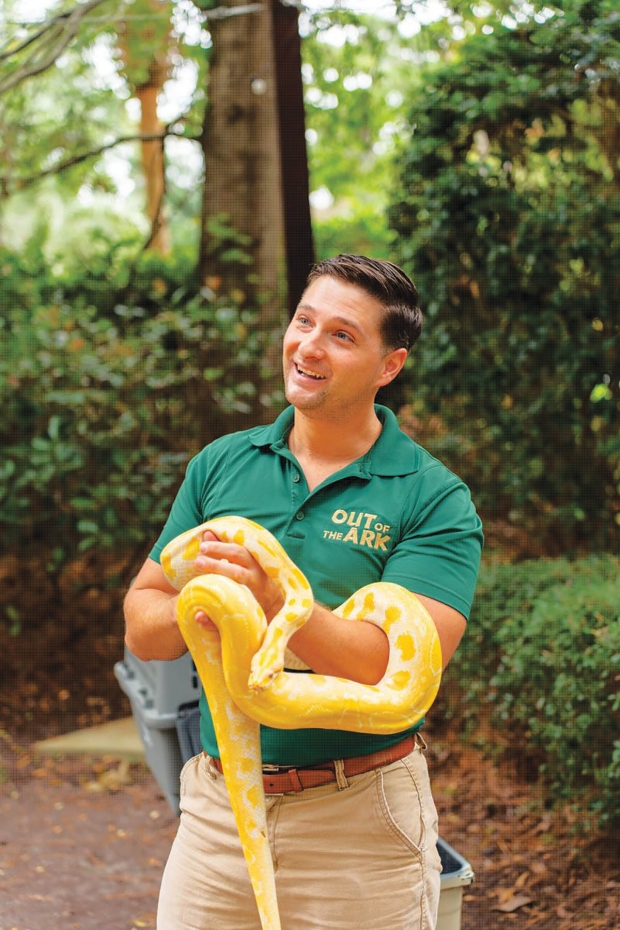
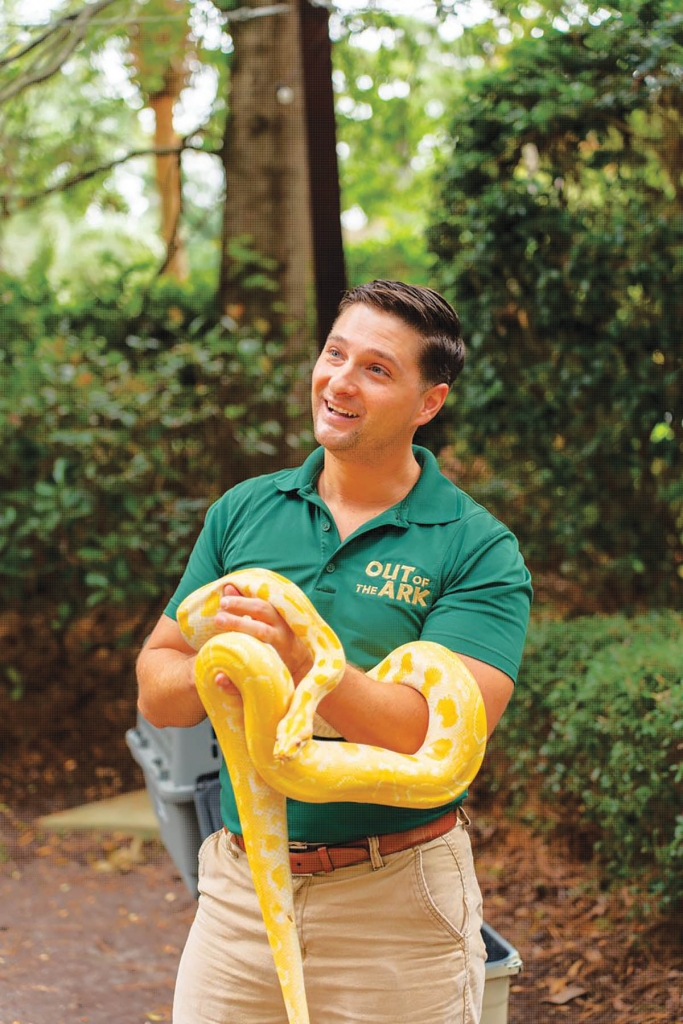
LaPierre says Sunny, his 10-foot albino Burmese Python, never fails to elicit the biggest response of the day. Unless actively feeding, they are sedentary, gentle creatures whose beauty cannot be denied.
“Snakes are super important,” LaPierre says. “These guys, in their appropriate habitat, are vital to the ecosystem. They can eat up to 75-percent of the rodent population and are hi-tech, perfectly evolved. They have nearly microscopic sensors that can detect a shadow moving across their bodies. The heat pits along the side of their mouths can sense a temperature change as little as .001 degree.”
LaPierre has traveled, not only during his stint in the U.S. Army, where he was deployed to the Middle East, but also on assignments for the State Department, National Geographic and the Discovery Network.
“I did quite a lot of videography and photography before Out of the Ark. I’m a dive master so I’ve worked as an in-water guide for Discover’s videographers and have been involved in coral reef restoration and other programs.”
Sunny is a hit, especially with the kids, who seem to show little to no fear of this large mythological creature, and she is a sight to behold.
“The albino python has a tough time in the wild, sticking out like a traffic cone.”
In the wild, albino pythons represent about 1 in 20,000. In captivity, due to select breeding, they’re much more common. Their beautiful patterns are lacking melanin, the skin pigment responsible for the dark browns and blacks normally seen, leaving vibrant yellow and lighter markings behind.
Definitely not cute and cuddly, except maybe to others of her kind, Claudia, an Emperor scorpion, mesmerizes the crowd next.
“Scorpions are arachnids, in the same family as spiders,” says LaPierre, walking with the creature, bending low so each who wants to can get an up-close look.
“The Emperor Scorpion can live in groups of up to 100 or more,” he says. “She’s about two-years-old and will average a foot long when full grown. The only time they sting is if you step on them or put your hand [threateningly] in front of them. I’ve been stung by 12 different species of scorpion—it feels like a bee sting. The Caribbean Bark Scorpion was the worst. That felt like liquid hot metal running up my arm for a few hours, but they’re not really that dangerous—except in the Middle East where there are some particularly risky Scorpions—but it’s nothing like what’s depicted in the movies.”
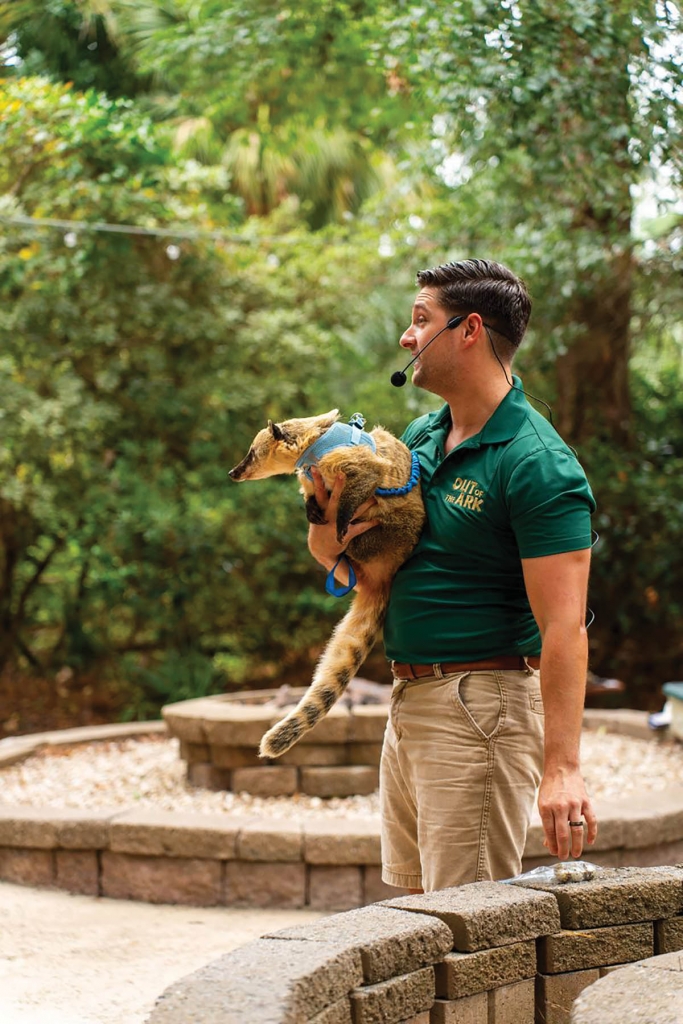
The truly cute and cuddly arrives a moment later in the form of Coca, a coati mundi (koo-wat-a-Monday), a small mammal whose habitat covers most of the warmest parts of the Americas.
“Coca is about two years old and can live up to around 25-years old,” says LaPierre. “She’s in the same family as racoons and can be found from southeast Texas, throughout Mexico, down through Central America and into the northern part of the Amazon in South America.”
LaPierre reaches into a small bag, hiding something in his hand, but Coca spots it and knows a snack is nearby.
“Coca starts her day like many of us,” he says, “munching on some eggs. She will eat these quail eggs, shell and all,” and she does, using her nimble fingers, agile paws and sharp teeth just like a racoon, or any other five-fingered creature.
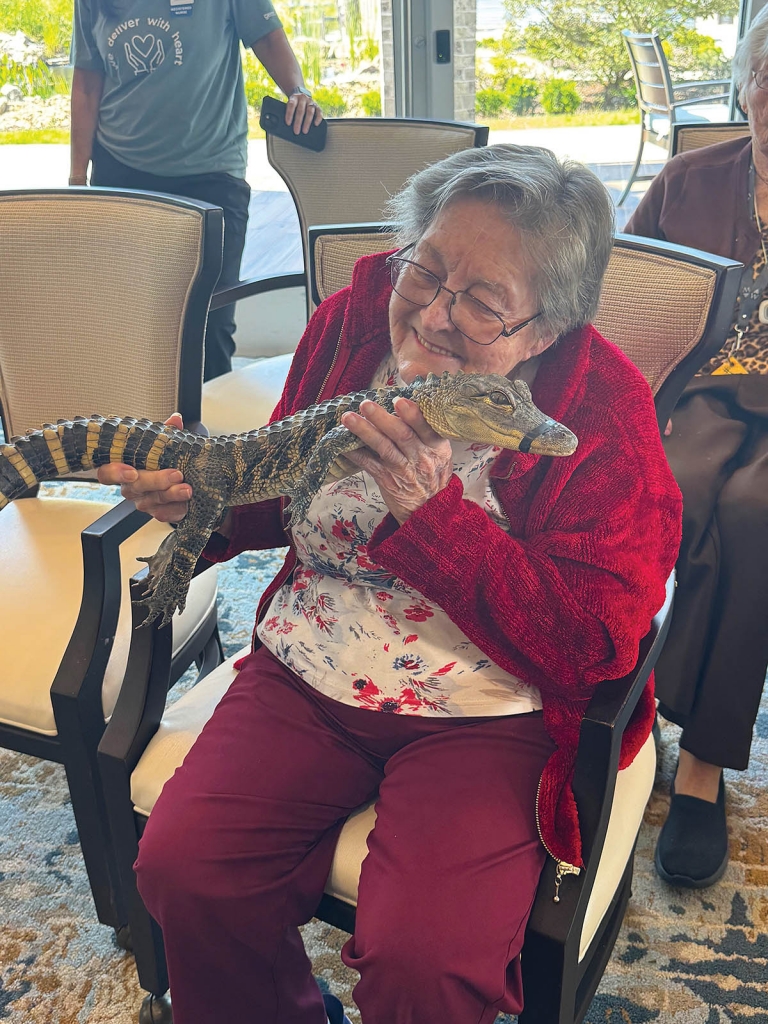
Last up is Chubbs, an American alligator, named in honor of Carl Weather’s Happy Gilmore golfing character whose fictitious career was cut short by an alligator bite.
“Chubbs is three years old,” says LaPierre, working the crowd. The gator’s mouth is taped shut to prevent any unwanted nibbling. Young and old enjoy stroking the rock-hard armored skin of the little guy, who seems nonplused.
LaPierre finishes the formal part of the show, opens up the floor to a lengthy Q&A and finally begins to transport his animals back to his van.
On this day he’ll have another visit to Watercrest Senior Living in Myrtle Beach and takes a moment to answer a call from a potential birthday party client.
“I’ll head back, offload the animals. Do enrichment and training, encourage natural behaviors. Keep them stimulated. We have around 60 animals right now. Snakes, birds, tarantulas, scorpions, lizards, geckos, tortoises, turtles, mammals like Coca, possums, sugar gliders, hedgehogs… I think that’s most of them!”
“About every three months we purchase all our food in bulk; our rodents, crickets, meal worms, mammal food, that kind of thing.”
The next day, he’ll start over again.
“We wake everybody up, do the food prep, see who’s in a good mood and who’s not, find out who wants to work and who doesn’t. We never guarantee any specific animals at any specific show. It’s really up to them and can vary quite a bit. Then we pick our animals for the first show.”
“We’ve got a 60-pound tortoise, who’s generally happy, but on a bad day, Franklin can hide in his shells, hiss at you—that’s always fun—or even charge. On those days Franklin stays home.”
“We do church groups, Scouts, birthday parties and a lot of the annual festivals. Sometimes it’s just me, but we have four additional staff that also do shows and community events, sometimes simultaneously, but usually it’s me. These are my kids and I’m very protective.”
“We do a total clean twice a week, a soft clean in between, and do a look, listen and feel, and enrichment every day. We want and need our animals to be and stay healthy. We stay in close contact with our veterinarian team and keep the animal’s well-being our top priority.”
“Obviously, we need to support ourselves through the business, but most of the profits go back into the care of the animals and then conservation projects we’re a part of or donating to. We like the Second Chance Bird & Reptile Rescue in Rochester, N.Y. They do amazing work, especially with exotic birds and reptiles. Also, the Amphibian Foundation in Georgia is another one of our favorites.”
“At the end of the day I like to spend a couple of hours with the parrots,” says LaPierre. “You never know what they might have to say.”
For more information visit: www.outofthearkshows.com