
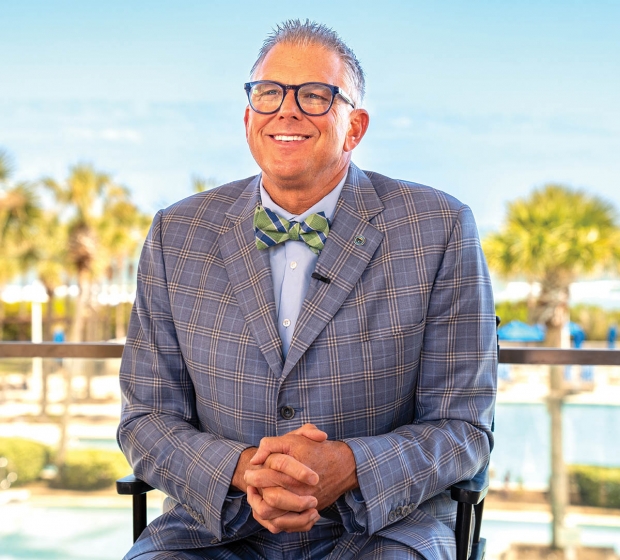


After spending nearly a decade as leader of Topeka, Kansas Greater Topeka Partnership, an umbrella of collaborative organizations including its Chamber of Commerce, Downtown Topeka, GO Topeka and Visit Topeka, Matt Pivarnik answered the call in late 2024 to take a similar leadership role at the Myrtle Beach Area Chamber of Commerce and Convention Visitors Bureau.
On March 1, 2025, the announcement of Pivarnik’s hiring was made after a comprehensive search led by a committee of community leaders named him as president and CEO of the 501(c)(6) nonprofit. Some 150 applicants were vetted for the position. Pivarnik succeeded interim CEO Tracy Conner when Karen Riordan resigned her position in June 2024 after nearly seven years leading the organization.
Since its first charter in 1938 the MBACC and affiliated organizations have helped transform and support the sleepy, once nearly unknown seaside towns in its service area—Pawleys Island to Little River, and west to Loris and Aynor. The entire region has become a thriving economic engine now creating some $26 billion in total annual economic impact. With close to 20 million visitors each year, sustained population growth, and continuing migration to the region, the MBACC sees itself as ‘the unified voice of the Grand Strand’s business community with a ‘mission to promote, protect and improve [area] businesses.’ A tall order, but one Pivarnik welcomes.
The role of president and CEO of the MBACC and CVB, or any chamber or visitor’s bureau for that matter, requires a specific skill set that is mastered only by a relatively small group of men and women. So, what does it take, exactly, to be successful in a pressure-driven environment where money, big money, jobs, and the very reputation of a city or region are on the line?
We sought the answer to that question by spending the better part of the day with Pivarnik to gain some insight into his management style, his outlook for the greater Grand Strand region, and to get a feel for what it takes to succeed in such a challenging role.
Pivarnik, 57, has been up since 4:30 a.m. and engaged in his routine long before he arrives at the Chamber’s headquarters on Oak Street in Myrtle Beach. We first meet in his still-undecorated office.
“It shows you how much time I spend here,” he laughs, pointing out the unadorned walls. “I’m 60 percent out of the office and 40 percent in. I need to be out in the community. That’s where the work is.”
Pivarnik is in his signature bowtie, and I notice he’s quite tall, but so convivial and engaging that his physical presence is not imposing.
“I’m about six-foot-five,” he answers, a little forlorn when I ask about his height. “I used to be six-foot-six.”
And the bowtie?
“I wear one here and there. I’m headed to Columbia this afternoon. Everybody in Columbia wears one,” he chuckles.
While it’s true much of the job is spent outside the confines of his office, meetings among his executive team and department heads are necessary and inevitable. We change locations to one of several meeting rooms to find staff already engaged in lively discussion. Jimmy Gray, president of the MBACC, Stuart Butler, president of Visit Myrtle Beach, along with VPs and department directors are a connected, collaborative team. Pivarnik greets his crew and they spend close to an hour discussing long-range plans and a never-ceasing calendar of events. They finish by discussing the upcoming week and anything pressing for the day. Everyone leaves the meeting with new action items on their task lists.
Back in Pivarnik’s office he checks in with his assistant, Sharon Leonard, who reminds him of a 10:30 in-house appointment. We have a moment to catch up, and I ask him about a ‘typical’ day.
“There is no typical day,” he says, “but I will say the beginning and ending of each of my days is fairly standard. I have a meticulous morning routine. I’m up at 4:30 every day and start by, I call it ‘scribing’ or journaling. I jot down things I’m thankful for, worried about, maybe a recap of the day before. I started doing this in 2021, and it's so great to be able to go back in time and discover ‘what did I say on this day in 2021, and 2022, and 2023…’ It’s really a cool thing. What it does for me is that it reminds me that 99.9 percent of the things I was worried about never come to fruition.”
“Then I work out—I have some equipment in my garage—every morning.” In 2025 he says he managed 364 days of training, missing only one due to food poisoning.
“After that I have a little prayer and quiet time. I do some reading and devotional stuff, and then I get ready for work. Before I leave home, I have a prayer with my wife and I’m off to start my crazy day.”
“On weekends all bets are off,” he continues. “My wife, Wendy, pokes fun at me about it, but yes, I’m highly disciplined.”
The Pivarniks have three grown children and three grandchildren, some of whom live in the Winston-Salem, N.C. area. Their proximity was an unexpected bonus for the couple as they planned their relocation from the Midwest to coastal South Carolina.
Pavarnik is given a script developed for a pre-taped short television appearance he will make on the Montel Williams reality show Military Makeover. Each episode follows a worthy military family who receives, at no expense, a full remodel of their home. In an episode airing in March, the family will also receive an all-expense-paid trip to Myrtle Beach where Pivarnik breaks the news to them via a congratulatory video. There’s no need to go to a studio off campus for the recording; MBACC multimedia producer John Muse and staff are tech savvy and run their own in-house production facility.
Arriving at the downstairs studio, the crew is ready with the lights, camera and action. The teleprompter is loaded with the script and Pivarnik takes his place in front of the backdrop, a coastal beach scene we would all recognize immediately.
After a few practice read-throughs he gets a take that all are happy with. Later in the day the digital file will zoom across the ether to the show’s producers, ready for inclusion, and ready to capture the joy on the military family’s faces. Easy-peasy.
While some tasks are just fun parts of his day, the bigger picture and what’s at stake sometimes weighs on him. Pivarnik regularly consults with his muse, Brad Dean, former MBACC CEO and friend of many years. Dean served at the MBACC between 1996 and 2018 and he led the organization to national recognition. Under Dean’s watch the MBACC was named Chamber of the Year by the American Chamber of Commerce in 2015. He left for Puerto Rico in 2018 to run the newly formed Discover Puerto Rico. In 2025 Dean resigned his position to move back to the lower 48 after accepting a position as president and CEO of Explore St. Louis.
“Brad Dean and I are old friends, and I think the world of him,” says Pivarnik. “We’ve stayed in touch. In 2018 I had been approached by a search firm as a name that came up for Brad’s replacement. At the time I had no interest. I had my home, family, kids in school and had made a commitment to Topeka and just wasn’t interested. When the call came again in 2024, things had changed. My wife and I made a quiet visit to the area for three days and didn’t tell a soul we were here. It was our anniversary and we had a wonderful dinner at Hook & Barrel, stayed at the Marriott Grande Dunes, and really researched the community. We both agreed that we thought the area would be a great fit for us. I told the search firm to count me in as officially interested, and here we are.”
“[Brad and I] talk from time to time,” Pivarnik continues. “He tells me I’m on the right track, even if it means changing some of the things he implemented. All of our organizations will continue to go through a serious strategic planning initiative. I am not a status quo guy. I think what we do within this organization is paramount and critical to not only the businesses in the region, but the residents, too. I am a change agent. I’m pretty sure that’s why I was brought here.”
Pivarnik likes to talk about the MBACC’s ‘core values,’ something they’re tweaking and will commit to the permanent record.
“Everyone here needs to adhere to these standards,” he says, referencing a document still in the works. “An obsessive passion and love for the community, full collaboration—we don’t care about credit, just that the job gets done. We must be visionary—let's be futurists and look out beyond the horizon. Integrity and ethics, that’s nonnegotiable. Everything we do needs to be viewed through an ethics and integrity lens, and finally excellence and quality. I’ve asked our team to study these core values and ask them to reflect on how they do or do not relate, saying ‘If these are not also your core values, then we’re probably not a good fit.’”
Helping to market the greater Myrtle Beach area to the rest of the country, and even internationally, is the focus of Visit Myrtle Beach president Stuart Butler, whose single task is to increase tourism. Pivarnik has an upcoming one-on-one with Butler.
“The old annual review thing is not as in vogue as it once was,” says Pivarnik. “It has all kinds of inherent problems, like waiting a year to find out [what your boss thinks]. Some companies are more aggressive and do it every six months, but we’ve implemented a monthly one-on-one with our directors. It’s more casual. The objective is to create monthly two-way feedback to facilitate open and direct communication between key members and managers.”
Feeling voyeuristic, I offered on more than one occasion to excuse myself, not wishing to intrude on this review session.
“No, no, you’re fine, and Stuart is fine,” he says. “Look, the truth is I have to wrack my brain to find any constructive criticism of him at all. He is a rock star. Brilliant. We’re so blessed to have him.”
Pivarnik has glowing things to say, at least to me, about nearly every staff member we encounter. He’s uncommonly unguarded and transparent, the kind of boss most of us would dream of, and his approach is infectious by design.
“At the end of our one-on-ones, I ask the manager to make a positive call-out [regarding one of their staff or a particular project], but also to dig deep to find one thing that’s an opportunity for improvement.”
“Stuart and I talk a lot—in fact we’ll be in the car for six hours together going to Columbia and back for a tourism meeting—but I also ask all my one-on-ones for feedback on me,” says Pivarnik. “Is there anything I could or should do differently, anything about me or my approach that annoys them.”
With Butler’s arrival, the meeting is underway. There’s wonky business management talk about vertical integration, opportunities for development, and other buzzy terms and phrases all with real world applications. They discuss A.I., social media and other trendy topics and how they’re impacting the Chamber’s mission for good and bad.
“I was a hot shot marketing guy 25 years ago,” says Pivarnik, “but now, Stuart and his team are beyond me. Today’s marketing is sophisticated and technical; I couldn’t do it.”
“I’ve had a meeting with one of our analytic agencies in preparation for a board presentation,” says Butler, “and they’re using A.I. to predict our 2026 occupancy. Through modeling, trends, things like gas prices, consumer index, inflation, regional unemployment—it all plays in. We believe that 2026 will be essentially about the same as 2025. We know that precipitation has increased every year for the last four years in a row. Rain hurts us more than any economic pressure. So that’s a bit of an unknown.”
“Matt has changed the culture not only here but in the community with a concept he brought to us from Topeka,” adds Butler, “something he calls ‘radical collaboration.’ We may have different opinions on how best to tackle an issue, but we recognize we’re on the same team and work toward finding solutions together.”
With Butler’s one-on-one complete, lunch is next on the agenda and Pivarnik, Butler and Jimmy Gray convene at Thai Bistro in Myrtle Beach, one of several favorite eateries among staff. Discussions are underway of pending legislation, including a resolution to name a future I-73 highway project The President Donald J. Trump Highway.
Earlier in the day I asked Pivarnik if his job was political.
“The Chamber is focused on legislative success, government affairs, and to remain well represented in Columbia and Washington D.C.,” he said. “It is a political job, but if you stay focused on what’s best for the community, it becomes less political and more strategic. The relationships required between [the Chamber] and local, state and federal government are significant. Though it is political, it’s non-partisan. ”
“I consider myself having a lot of bosses,” he says. “I work for the community and elected leaders, but officially, legally and technically, it’s the board of the MBACC I first answer to.”
“The government affairs and legislative part of the job can be taxing,” he adds. “I’d rather work on relationships instead of lobbying. It can be heavy. If we don’t succeed our community won’t succeed. If you go to any community and find a chamber that’s not good, you’ll find a community in decline. It’s an awesome responsibility. The way the world is now, [the social media warriors] all have an opinion about what you’re doing or not doing and 99 percent of the time they’re misinformed. It can be frustrating. We keep our blinders on and keep running the race.”
After lunch, Pivarnik and Butler will carpool to make their afternoon meeting in Columbia. Pivarnik says he was spoiled in Topeka by at least one thing.
“I was literally across the street from the Kansas State Capitol but now find I’m three hours away from Columbia.”
Later in the week there will be meetings with Horry County Council and new Myrtle Beach Mayor, Mark Kruea. There are fundraising oyster roasts to help the Chamber’s GSYP (Grand Strand Young Professionals) raise money for their Substitutes for Santa program. There will be more events, ribbon cuttings and more meetings.
Pivarnik says that it can be easy to burn out in a job like nearly any one of the positions at the MBACC.
“It’s a busy place for the team,” he says. “There are morning breakfast meetings, then all day at work with a few events possible in the evenings, and then a weekend full of events and activity only to turn around again and start all over on Monday.”
For Pavarnik, it’s family, focus, mindfulness, routine and even sleep hygiene that helps him to strike the work/life balance that can be so tricky to manifest.
“My evening routine is to look at my calendar for the next day, update my task list, and just prepare myself in general for what’s ahead. I turn off all blue screens by 8:30—all TVs, laptops, phones, all off.”
“I consider my job fun and energizing. I covet spending time with my family, and especially those grand kids. My job is eclectic. I probably have ADD, so being able to bounce from topic-to-topic works for me and knowing that what we’re doing is good for the community is very rewarding. We create things that will last long after we’re gone and create prosperity for our region.”
I asked, “Why Myrtle Beach?”
“I had been to Myrtle Beach on multiple occasions,” he answers, “golf trips, a Chamber convention, vacations… and loved everything about the region, the topography, the climate, the people…but because of Brad Dean, whom I respect and admire, I’d been closely following the Grand Strand’s progression for a long time, and was duly impressed. Ultimately if you’re going to do a job that’s fun, but also hard, why not do it in a place you absolutely love?”